Neolithic Orkney (Part 2 - Maeshowe)
(Or Chambers that are Maeshowe)
I did start struggling to write a blog on Maeshowe so I started with the other chambered cairns I visited first. Not because the visit wasn’t excellent (it was), not because Maeshowe isn’t one of most amazing neolithic sites I've visited (it is), but simply because Historic Environment Scotland makes some of the experience so utterly unpleasant. First off, the booking problems I mentioned previously. When I've been on Orkney prior to this trip, I've tried to get in on a tour on the only day I've had free, and been denied every-time. This time, I had to book 3 months in advance to get the day (but not the time) I wanted. There were empty seats on my tour which suggests they can fit people in - they just couldn’t be arsed with me.
Seats, that’s the next issue, its just off the road but you have to assemble at the visitor centre, get loaded onto a minibus then driven to the private parking spot then herded down the path to be allowed in. They do 4 tours a day. It lasts 20 minutes, so even if they did 2 an hour for 4 hours a day they'd double the capacity, solve the booking issues and make it easier for tourists to see the site.
Finally you can't take pictures inside, apparently due to too many people being inside... my point I guess.
Now the moan is out the way, lets talk about the site. Maeshowe differs from the chambered cairns in the previous blog simply on scale. The entrance passageway is tall enough to duck walk down (even for me), once inside, the central chamber is much bigger. There is room for the 20 odd people on the tour and the roof is very much higher. The side cells too are different. They're raised up about 80cm, so there’s a step into them, the small entrances are still larger than that of Cuween and Wideford. Inside there are four standing stones that the data has shown spent sometime outside before the chamber was presumably constructed around them. These stones may have been part of a previous stone circle that then got protected or otherwise covered over. There is also an empty 'socket' of a stone at the back of the chamber. Larger than the stones of Stenness (next blog) over the road this stone must have been a fair size and possibly ended up in the construction somewhere.
The size and complexity of the structure suggests something important, but no human or animal remains have been found. Whatever its purpose, it doesn’t appear to have been used for remains of the dead.
There is an astronomical alignment here however. During the winter solstice the low sun will shine down the entrance way passage and light up the interior. Here again comes the standard archaeology reasoning of 'looks cool' must have been for 'religious' reasons. It will happen for about 6 weeks, which probably gives enough time for one clear day during the Orkney winter which to me suggests only the 'looks cool' part applies. Unless they got everyone assembled on a good day and hoped clouds wouldn’t blow in in the mean time as they prepared for the religious aspects.
So having been build 4-5 thousand years ago and older than the pyramids there is something here that meant a great deal (given the effort) to the people of the nearby neolithic villages (next blog) and for reasons of their own expanded a great deal of effort and energy to build a very large structure over already existing stones and to ensure its aligned to the setting sun on the solstice.
The inside of the structure is assumed to have been sealed up 4000 years ago and sat undisturbed until 1000AD (give or take a few hundred years) when the Vikings came along. Its mentioned in the Sagas as 'Orkahaugr' which translates to Orkney mound. Sometime in the 1100's a Viking group broke in through the roof and left what can only be described now as graffiti. What they left seems to indicate they knew the cairn and chamber existed, but largely they left graffiti that pointed out 'Olaf was 'ere'. Literally one piece is 'Ottarfila carved these runes' and one higher up entry notes (someone) 'was the highest rune carver'. It is however, despite that, one of the largest collections of runes outside Scandinavia, containing both tree runes and the more usual Nordic runes (not sure on correct name for these).
The runes are really only visible when the lights are turned off and the guide shines torch light over them, although once seen like this I was able to pick most out in the ambient light.
For all these reasons and more its a really remarkable place to visit. It still astounds me that people basically like me, built this thing, this place with man power and will alone, for a purpose we still don't (and may never) know. Close by is the wider neolithic landscape of standing stones, villages and stone circles that will be the subject of my next blog (probably) but Maeshowe stands on its own as being something utterly incredible and then you add in some impressive Viking history too it becomes ever more remarkable.
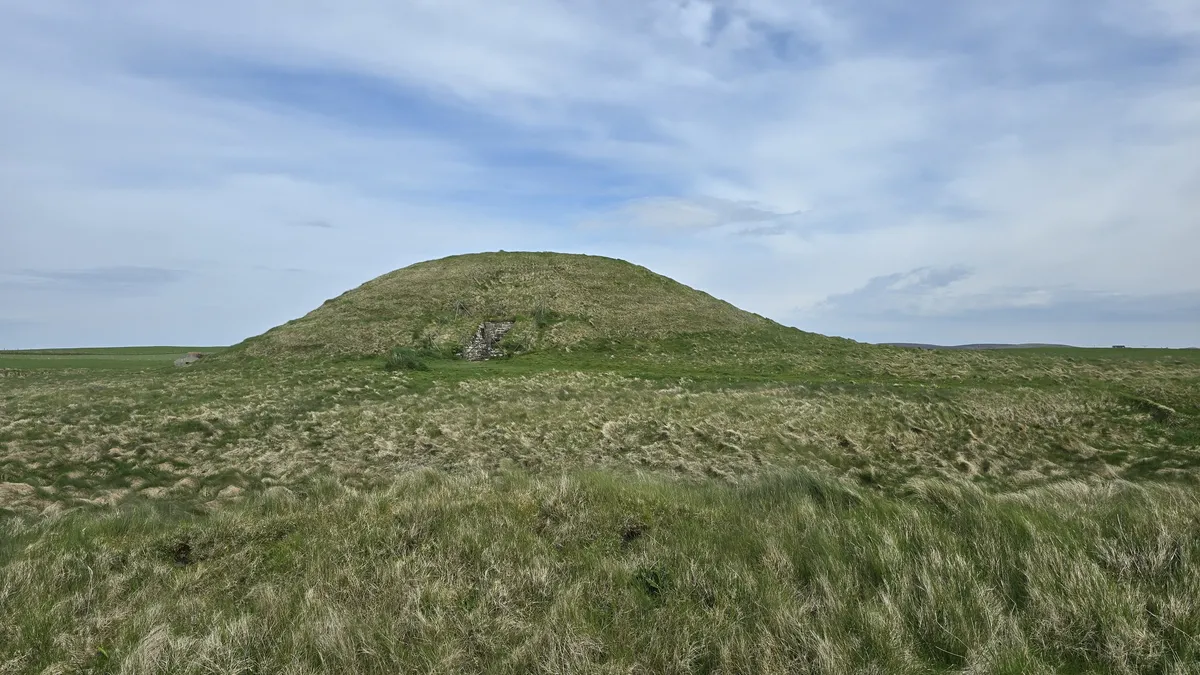 Maeshowe on the approach to it (no pictures permitted inside)